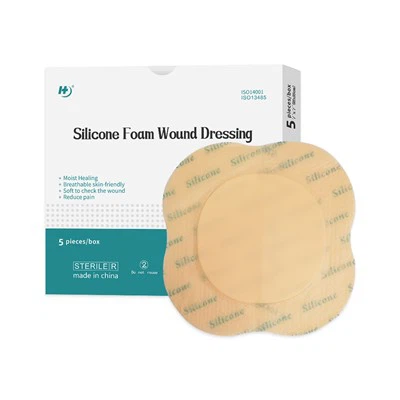



As a new type of dressing, hydrocolloid dressings offer significant advantages in wound care due to their innovative design and material properties. The high biocompatibility and water content maintain a moist environment, promoting cell regeneration and epithelial growth.
Hydrocolloid dressings absorb wound exudate into a gel-like substance, providing optimal moisture retention to prevent dryness and infection. Furthermore, their strong self-adhesive properties and the ability to be freely cut allow them to conform to irregular wound surfaces, enhancing comfort and a tight seal.

BENEFITS:
Accelerate Wound Healing
Maintain a Moist Environment
Absorbs exudate to form a gel layer, maintaining moderate moisture, promoting cell migration and epithelial growth, and shortening the recovery period compared to traditional dry healing.
Reduces Scar Formation
A moist environment inhibits scab formation and reduces the risk of excessive fibrous tissue growth, making it particularly suitable for areas of the face and joints.
Enhanced Protection and Comfort
Physical Barrier
The airtight design blocks the intrusion of bacteria, dust, and other foreign matter, reducing the risk of infection.
Waterproof and Flexible
The polyurethane film on the surface provides waterproofing, while the elastic material can be freely cut to fit irregular wound surfaces (such as joints) and resist removal during movement.
Reduces the Pain of Dressing Changes
Self-adhesive yet non-sticky to new tissue, preventing secondary damage during dressing changes. The gel layer cushions external pressure.
Convenient and Economical
Flexible Operation
Adaptable to custom sizes, suitable for a variety of wounds, from small acne to large pressure sores. Reduce dressing change frequency
High exudate absorption capacity extends wear time and reduces care costs.
INDICATIONS
Selection Considerations
Size and Type Matching: The dressing should cover 2-3 cm of the wound edge and can be flexibly tailored to the wound size, shape, and location. For wounds with low exudate, choose a thin or transparent dressing. For wounds with low to moderate exudate, use a standard ulcer dressing. For special areas (such as joints), use a pressure-reducing or butterfly-shaped dressing.
Wound Suitability Assessment: Suitable only for superficial wounds (e.g., abrasions, sutures), chronic wounds (e.g., pressure sores, venous ulcers), or peri-catheter protection. It is strictly contraindicated for infected wounds, wounds with exposed bone and tendon, full-thickness burns, or wounds with avascular necrosis.
Exudate Limitations: Hypertonic wounds (exudate exceeding 1-2 cm/day) should not be treated with this dressing and should instead be treated with a foam dressing. Cavity wounds greater than 5 mm in depth must be filled with an absorbent material such as alginate before covering with the dressing.
Key Instructions for Use
Wound Pretreatment: Thoroughly irrigate the wound base with normal saline to remove necrotic tissue and foreign matter. Gently dry the surrounding skin to prevent residual moisture that may impair adhesion.
Application Tips: Remove the protective film without touching the adhesive surface. Press from the center outward to secure the dressing, ensuring there are no bubbles. Joints should be reinforced with an elastic bandage.
Replacement Time and Frequency: Change the dressing immediately if it turns milky white, curls, becomes saturated with exudate, or develops an odor. If there are no abnormalities, change the dressing every 3-5 days for wounds with minimal exudate and every 1-3 days for wounds with moderate exudate.
Removal Method: Gently peel the dressing parallel to the skin. Moisten it with saline solution if necessary to reduce adhesion and avoid forceful tearing that could damage new tissue.
Other Important Notes
Abnormal Handling: The dressing may produce an odor or a purulent appearance due to gel formation. This is normal, but the wound surface should be flushed with saline solution to remove any residue between dressing changes.
Contraindications: Use with caution if you have allergies.

AVAILABLE types
Choose the one that suits you best.
U shaped hydrocolloid bandage

6*7cm
Certificate:CE/MDR
Advantages:
Significantly Reduces the Risk of Phlebitis
By applying the patch above the puncture site and along the course of the vein, it creates a physical barrier, reducing damage to the vessel wall from hypertonic medications or irritating fluids.
Clinical studies have shown that the gel layer formed after absorption of exudate can alleviate local inflammatory reactions.
Thin type hydrocolloid dressing

10*10cm 15*15cm 20*20cm
Certificate:CE/MDR
Advantages:
Reduced Risk of Skin Injury:
The highly biocompatible adhesive minimizes epidermal damage during detachment, making it particularly suitable for infants and children or patients with sensitive skin.
The hydrophobic layer reduces friction between the dressing and bedsheets, preventing device-related pressure ulcers.
Ultra-thin hydrocolloid dressing

10*10cm 15*15cm 20*20cm
Certificate:CE/MDR
Advantages:Special Area Adaptability
Joint/Facial Care
Conforms to the skin's curves, preventing curling or falling off during joint movement. It's especially suitable for irregular areas like the corners of the mouth and the bridge of the nose.
Aesthetically pleasing and invisible treatment
The translucent material, which mimics skin tone, conceals wounds (such as facial abrasions) in social settings.
hydrocolloid dressing(I.V. dressing type)

6*7cm
Certificate:CE/MDR
Advantages:
Reduces drug extravasation injuries.
The airtight design prevents irritating drugs from leaking into the subcutaneous tissue and protects the skin around blood vessels.
Secures the catheter.
The elastic material conforms closely to curved skin surfaces (such as joints). Combined with a transparent film dressing, it provides dual fixation, minimizing catheter migration or dislodgement.
Hot Tags: ultra thin waterproof hydrocolloid wound dressing, China ultra thin waterproof hydrocolloid wound dressing manufacturers, suppliers, factory, Hydrocolloid bandage, Hydrocolloid dressing foam, Hydrocolloid foam dressing, Hydrocolloid dressing with foam backing, Hydrocolloid wound dressing with foam